
Table of Contents
How Do You Cut Green Onions — And Which Cut Works Best for Each Dish?
Green onions (also called scallions) can be cut three ways depending on your recipe: simple coin-shaped slices for garnishes and cooked dishes, thin diagonal “hairs” for salads and ramen, or larger chunks for stir-fry. Always prep by rinsing, trimming the roots, and removing the top 1–2 inches before cutting. A sharp knife and a sliding motion — rather than pressing down — prevents crushing the delicate stalks.
Green onions add a fresh, bright punch to everything from stir-fries to salads to soups. Once you know the right cut for the right dish, incorporating them into your cooking becomes second nature.
Why the Cut Actually Matters
- Flavor intensity varies by cut — Thinner cuts have a milder flavor; thicker chunks deliver a more pronounced onion bite.
- Texture affects the dish — Fine hairs melt into salads and soups gracefully; chunks hold up in high-heat stir-fry without disappearing.
- Presentation counts — The right cut turns a simple garnish into something that looks intentional and professional.
- Both ends are usable — The white and light green sections carry the most flavor for cooking; the dark green tops work beautifully as a finishing garnish.
Expert Tip: How to Prep Green Onions Before Cutting
Start by selecting a good bunch. Look for scallions with vibrant, firm green leaves and roots still attached. Avoid any that look slimy, flimsy, or discolored.
- Rinse the scallions under cool running water.
- Remove any damaged or wilted sections.
- Place them on a cutting board.
- Slice off and discard the top 1–2 inches of the dark green ends.
- Cut just above the roots and discard the root end.
Your scallions are now ready to cut using any of the three methods below.
3 Ways to Cut Green Onions
1. The Simple Cut (Coins)
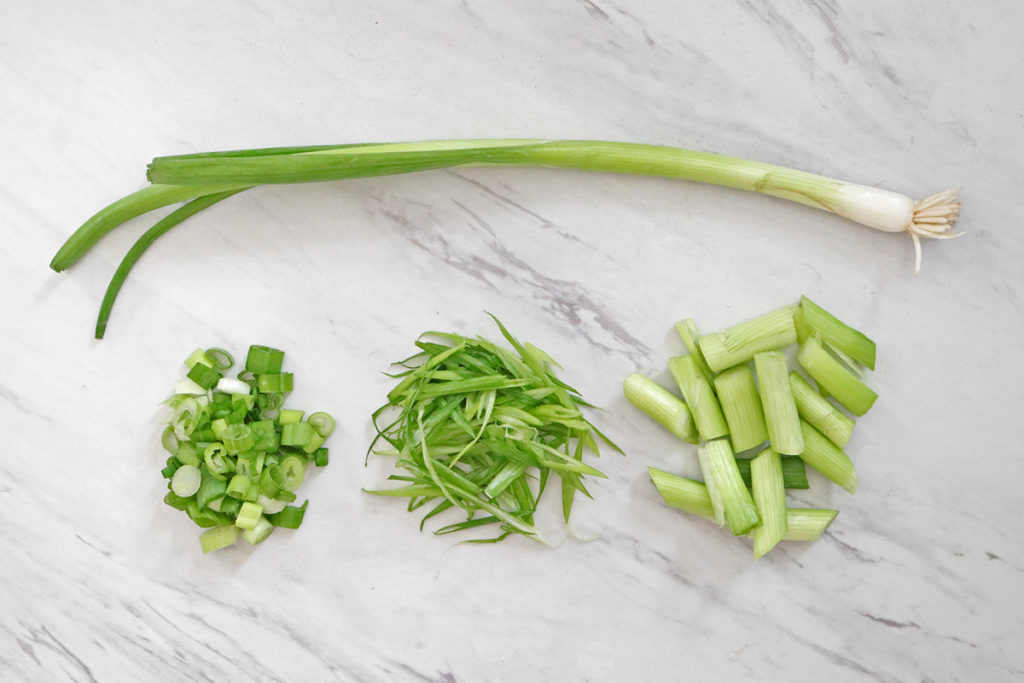
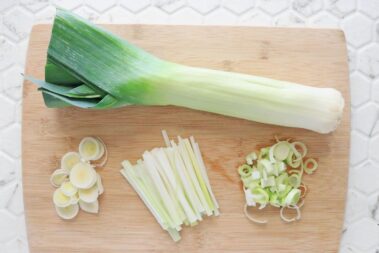
This is the most versatile and common cut. It produces small, round “coins” of scallion that work as garnishes, in cooked dishes, or anywhere you want a pop of flavor and color.
- Place the prepped scallions on your cutting board.
- Hold them in place with your non-dominant hand.
- Use a sharp knife to slide back and forth across the scallion rather than pressing straight down — this prevents crushing.
- Aim for pieces about ⅛-inch thick, adjusting thicker or thinner based on your recipe’s needs.
2. Scallion “Hairs” (Diagonal Slices)
This elegant cut produces long, fine slivers that work beautifully as a ramen garnish, in salads, or anywhere you want visual impact with a gentler flavor. The large surface area means the flavor is slightly milder than a coin cut.
- Position your knife at an extreme slant — almost parallel to the scallion stalk.
- Slice along the length of the scallion in one smooth motion.
- Adjust the thickness to your preference — these can be as fine or as substantial as the dish calls for.
3. Scallion Chunks
For stir-fries and other high-heat cooking where you want the scallion to hold its shape and contribute texture, larger chunks are the right call. These can be cut straight across or at a slant.
- Place your prepped scallions on the cutting board.
- Cut straight across or at a slight angle to create pieces ¼ to ½ inch long.
- Use immediately in stir-fries, sautés, or any dish where the scallion will be cooked rather than served raw.
How to Store Green Onions
In the fridge: Place uncut scallions in a jar or glass with a few inches of water, making sure the bulbs and roots are fully submerged. Store in the refrigerator. This method keeps them fresh for 1–2 weeks and you’ll often see new growth starting at the tips.
In the freezer: For longer storage, cut the scallions first — thawed scallions are much harder to cut cleanly. Spread the cut pieces on a parchment-lined baking sheet and freeze until solid, then transfer to a freezer-safe bag. Frozen scallions keep for 10–12 months and can be added directly to cooked dishes from frozen.
Recipes That Use Green Onions
- Baked Accordion Potatoes — A sprinkle of scallion greens is the finishing touch these crispy potatoes deserve.
- Vegan Seaweed Salad — Scallions are one of the main flavor players in this bright, healthy salad.
- Vegan Potato Salad — Uses the whole scallion for a balanced hit of flavor in every bite.
- Vegan Egg Salad with Tofu — Finely cut scallions add a burst of freshness to this plant-based classic.
- Vegan Cornbread with Carrots and Scallions — Once you try this version, plain cornbread won’t cut it anymore.
Frequently Asked Questions
What part of a green onion do you actually use?
You can use almost all of a green onion — the roots are the only part you discard. The white and light green sections near the base have the most intense flavor and hold up well to cooking. The dark green tops are milder and best used as a finishing garnish rather than cooked into the dish. When a recipe specifies “the white part,” use the solid stem up to where the stalk becomes hollow.
How do you cut green onions so they keep growing?
Cut the plant about a half-inch above the soil line and the leaves will begin regrowing within days. For store-bought scallions, place the root ends (about an inch of the white base) in a small glass of water on a sunny windowsill. New green shoots will emerge within a week and can be harvested multiple times before the plant exhausts itself.
Are scallions, green onions, and spring onions the same thing?
Not exactly. Scallions, green onions, and spring onions are actually names for different growth stages of onion greens, and there are subtle differences between them. Learn more about what distinguishes scallions, green onions, and spring onions.
What is the best knife technique for cutting green onions without crushing them?
The key is using a sharp knife and sliding it back and forth rather than pressing straight down. Pressing with a dull knife crushes the delicate hollow stalks and bruises the flesh, releasing more liquid and making the pieces look ragged. A sharp chef’s knife or santoku used with a gentle slicing motion produces clean, even cuts every time.
Did you find this helpful? Tag @CleanGreenSimple or use #CleanGreenSimple to share your kitchen prep tips!

[email protected]
- How to Mince Celery & Carrots - April 1, 2026
- How to Cut Green Onions (Scallions) - March 26, 2026
- 18 Scrumptious Vegan Thanksgiving Desserts - November 16, 2023
Thanks for this article, I never knew what scallions were and I have used them all my life. I’m 66 and I can’t wait to make scallion hairs! Proof that you’re never too old to learn every day!
I did not know how much I did not know about green onions (scallions) until I read this article on green onions (scallions). Thank you for putting in the time and effort to make this info available to me (the Masses).
I keep a jar in the refrigerator with prepared scallions soaking in ice cold water. As I walk past I take out one scallion, dip it in salt that I’ve sprinkled in my off hand, and reward myself with a treat as I go about my business. I try not to do this more than 3 or 4 times a day. It is a better “snack” than candy or cookies…and, frankly it just tastes good.
.